First eukaryotes: when cells swallowed power plants
Complex cells appeared about 2000 million years ago when one microbe engulfed another that became mitochondria.
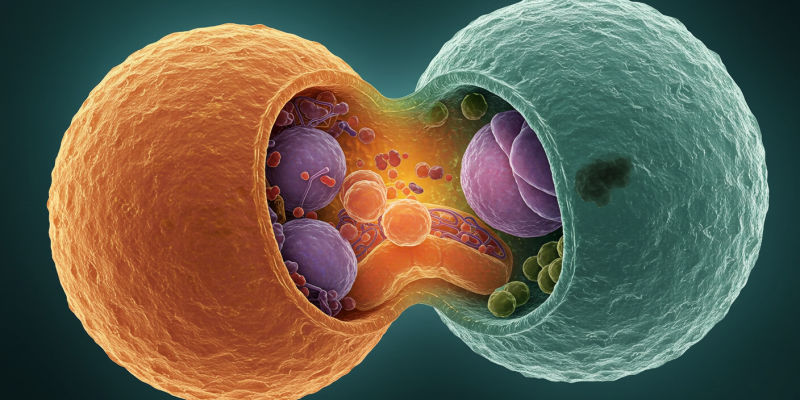
A merger two billion years ago
Around 2000 million years ago an archaeal host swallowed a bacterial guest instead of digesting it, keeping the lodger as an energy factory that became mitochondria with its own small genome.
The host provided shelter and food scraps while the guest made abundant energy, letting the combined cell grow 1000 times larger in volume than simple bacteria and support a nucleus.
Nucleus, sex and the road to us
Eukaryotes wrapped DNA in a nucleus, gained linear chromosomes, internal membranes and a cytoskeleton, then invented sexual reproduction that shuffles genes every generation for faster adaptation.
Chloroplasts came later by a second engulfment of cyanobacteria about 1500 million years ago, while Lynn Margulis revived endosymbiosis in 1967 and fossils confirm complex cells by 1600 million years.
- Mitochondria were once free bacteria with their own DNA.
- Chloroplasts came from engulfed cyanobacteria in plants.
- Nucleus protects DNA and enables complex gene control.
- Sex mixes genes and speeds evolution in eukaryotes.
- All animals, plants and fungi descend from one merger.