Paleozoic era: 300 million years from trilobites to reptiles
From 541 to 252 million years ago six periods ran from the Cambrian explosion to the Permian extinction of 90 percent.
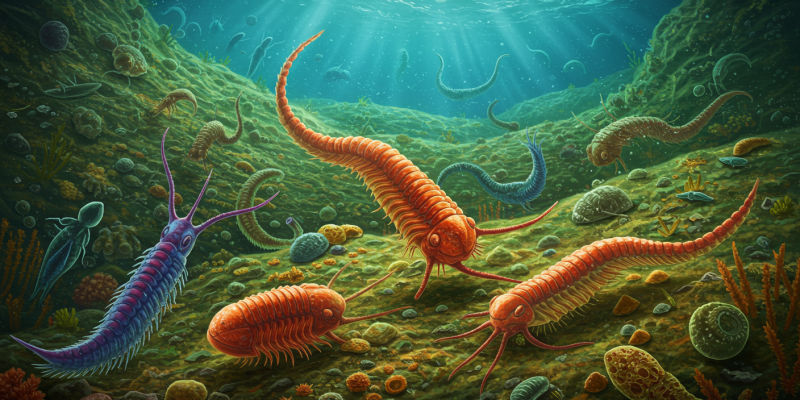
Six periods and Cambrian start
The Paleozoic lasted from 541 to 252 million years ago, about 290 million years split into Cambrian, Ordovician, Silurian, Devonian, Carboniferous and Permian periods. It opens with the Cambrian explosion 541 million years ago, when trilobites, anomalocaris and most animal body plans appeared in 20 million years.
Seas built reefs, jawed fish with 10-centimeter armor evolved by 430 million years ago, and plants crept onto land near 470 million years ago. By the Devonian 419 to 359 million years ago, lobe-finned fish grew legs, giving 3-meter amphibians that breathed air.
Forests, reptiles and Permian end
The Carboniferous 359 to 299 million years ago grew 30-meter scale trees and coal swamps, while giant dragonflies with 70-centimeter wings flew in 35 percent oxygen. Amphibians laid eggs in water, but near 312 million years ago amniote reptiles with waterproof eggs escaped ponds for good.
The era ended with the Permian extinction 252 million years ago, when Siberian volcanoes warmed Earth 10 degrees and killed 90 percent of marine species and 70 percent on land. Only small reptiles, ancestors of dinosaurs and mammals, survived in a hot desert world.
- Paleozoic: 541 to 252 million years
- Periods: 6 from Cambrian to Permian
- Cambrian: 541 million years, trilobites burst
- Land: plants 470 M, reptiles 312 M
- Permian: 252 M, 90 percent sea species lost