Archean eon: first life in a methane sky
From 4.0 to 2.5 billion years ago first cells appeared near 3.8 billion years ago under an orange methane haze.
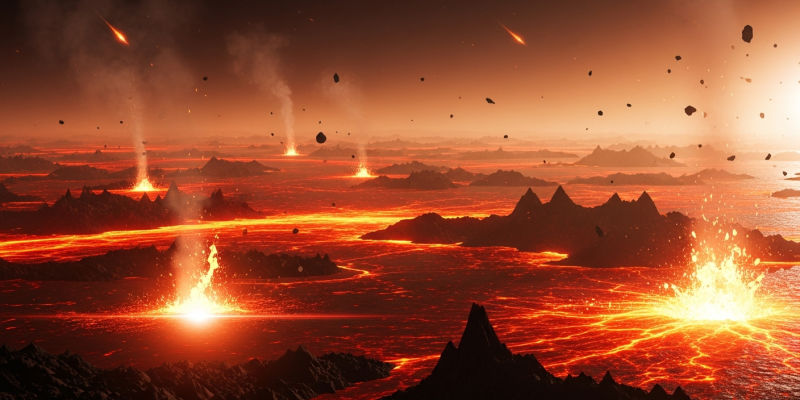
First cells without oxygen
The Archean lasted from 4.0 to 2.5 billion years ago, fully 1.5 billion years when life began. By about 3.8 billion years ago chemical traces and 3.5-billion-year stromatolites in Australia show photosynthetic microbes building layered mounds in shallow seas.
The sky was orange with methane haze and no oxygen, so early cells lived by fermentation and later by anoxygenic photosynthesis. Oceans were warm and iron-rich, continents were tiny volcanic islands, and days lasted only about 15 hours as the Moon braked Earth.
Continents start and oldest rocks
Early continents grew when volcanic arcs collided and stuck, forming hard cratons that still hold up Canada and Greenland. The oldest well-preserved rocks, the 4.03-billion-year Acasta gneiss in Canada and 3.8-billion-year Isua rocks in Greenland, both date to this violent building time.
By 2.7 billion years ago shallow platforms hosted vast microbe mats, pumping waste that would later become oxygen. Impacts still hit, but gentler, letting rivers, beaches and tidal flats spread — perfect nurseries where evolution tested the first photosynthesis and cell division.
- Archean: 4.0 to 2.5 billion years ago
- First cells: about 3.8 billion years ago
- Air: methane haze, zero oxygen
- Fossils: 3.5-billion-year stromatolites
- Rocks: Acasta 4.03 billion, Isua 3.8 billion